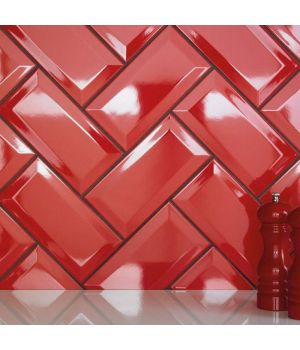
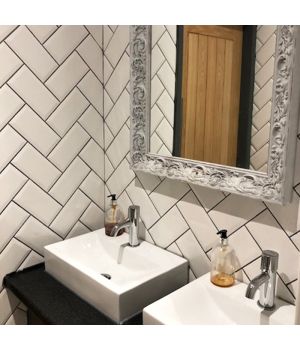
Herringbone Wall Tiles

Shop By
Shopping Options
Category
Rating

Herringbone Tiling Ideas

Where a straight-laid tile sits quietly on the wall, a herringbone pattern draws the eye across the surface. The same tile in the same colour reads completely differently when the angle changes — and that is precisely why the layout has remained a go-to choice for UK homeowners for generations.

What are herringbone wall tiles?

Herringbone wall tiles are not a specific tile type — they are standard rectangular tiles laid in a V-shaped zigzag pattern, with each tile placed at a 45-degree angle to its neighbour. The name comes from the resemblance to a fish spine: alternating angles meeting at a central line to create a continuous directional pattern across the wall surface.

Choosing tiles for herringbone walls in each room

The herringbone layout is flexible enough to work in almost any room, but what makes a good herringbone kitchen wall differs from what makes a good herringbone bathroom wall — and both differ from a feature wall in a living space. Here is what to focus on in each setting.

For kitchen tiles, a herringbone splashback is one of the most effective applications of the pattern — contained, practical and high-impact without requiring the entire kitchen to be redesigned around it.

Kitchen herringbone tips:

  • Glazed porcelain and ceramic tiles are the practical choice for a herringbone kitchen splashback — smooth, non-porous and easy to wipe after cooking without specialist cleaning products.
  • Coordinate the tile colour with either the worktop tone or the cabinet finish, rather than trying to pick up both — one visual connection anchors the splashback without making it feel over-matched to the kitchen.
  • A white or pale gloss herringbone splashback between dark cabinets creates strong contrast and makes both elements read more clearly — the light tile and dark unit each define the other.
  • Keep the herringbone splashback to a single panel between worktop and wall units rather than extending it across the full kitchen wall — a focused panel reads as more deliberate than a continuous tiled surface that spreads beyond its natural boundaries.

For bathroom tiles and living spaces, the herringbone layout suits both wet-area wall coverage and dry-area feature applications.

Bathroom and living-space herringbone ideas:

  • A full herringbone shower wall in a porcelain brick tile — particularly in white gloss — reflects light in multiple directions and makes the enclosure feel significantly larger than a flat-laid tile in the same colour.
  • Behind a freestanding bath, a floor-to-ceiling herringbone panel in a coloured or patterned tile creates the kind of focal point that anchors the whole bathroom around a single strong element.
  • Above a basin on a half-height tiled wall, a small herringbone panel can frame the mirror and vanity area as a distinct zone without tiling the full bathroom in the same layout.
  • In a living room, a herringbone-tiled chimney from hearth to mantel makes a confident decorative statement — particularly effective in a coloured tile that would feel too intense if applied across a larger wall.
  • In a hallway or entryway, a half-height herringbone dado gives a period-appropriate finish that is more interesting than straight-laid tiles and handles contact-zone marks more practically than painted plaster.

For broader inspiration on how herringbone and other layouts translate across different rooms, the 101 wall tile designs to impress the neighbours article is a useful starting point.

Herringbone layout tips

Layout and grout tips for herringbone wall projects:

  • Always set out the herringbone pattern from the centre of the wall and work outward — this ensures the V-shapes are symmetrical at both edges and prevents the pattern from looking as though it drifts to one side.
  • Account for increased tile waste when planning quantities — the angled cuts required at the perimeter of a herringbone wall use more material than straight-bond layouts, typically adding 10–15% to the standard waste allowance.
  • For a splashback or contained feature panel, the 45-degree classic herringbone works well regardless of tile size — for a full bathroom or kitchen wall, a straight herringbone layout reduces the number of angled perimeter cuts considerably.
  • A matching grout on a white herringbone kitchen splashback keeps the wall feeling light and spacious — introducing a dark contrasting grout in a small kitchen can make the splashback feel visually heavy even with a pale tile.
  • Where a herringbone panel meets a plain-tiled surround, aligning the grout joint colour across both sections keeps the transition looking deliberate rather than like two separate installations that happened to end up adjacent.

For more layout ideas across herringbone and other wall tile arrangements, the 101 wall tile designs to impress the neighbours article covers a wide range of real-room approaches.

Compare herringbone wall tile formats

The tile format you choose shapes how the herringbone pattern reads on the wall. Here is how the three main options compare.

Tile format Main herringbone benefits Best wall uses
Small brick-style tiles (e.g. Liso White Gloss Brick Tiles) Tight, well-defined zigzag pattern — the compact format makes the herringbone grid crisp and detailed. Kitchen splashbacks, bathroom feature walls, shower enclosures and half-height bathroom panelling.
Longer plank-style tiles Pronounced directional effect — the length of each tile makes the V-shape larger and more graphic on the wall. Full bathroom and living-room feature walls where a bolder, more architectural herringbone is the brief.
Larger rectangular tiles Fewer grout joints per m² — the pattern reads cleanly and covers wall area more quickly than smaller formats. Straight-herringbone layouts in larger bathrooms, kitchen walls and hallway feature panels.

Herringbone wall tile prices

The tiles used for herringbone walls span a wide price range at TilesPorcelain, from straightforward brick-format ceramics through to designer coloured finishes. Prices per m² vary by tile size, finish and any deals currently running — the product grid always shows live pricing.

One practical note: because herringbone layouts use more material than straight-bond layouts — typically 10–15% more due to angled perimeter cuts — factor this into your m² calculation before ordering. The product pages show coverage per box, which makes it straightforward to adjust the quantity accordingly.

Price band Approx. price per m² Typical products
Good-value Around £20–£30 per m² Plain gloss and matt brick tiles in white, cream and neutral tones — the everyday herringbone workhorse.
Mid-range Around £30–£45 per m² Coloured gloss and matt tiles, bevelled brick formats, plank-style tiles and wider finish options.
Premium Around £45–£60+ per m² Designer coloured ranges, specialist finishes and larger plank formats for statement herringbone walls.

Herringbone wall tiles FAQs

Do I need special tiles for a herringbone wall pattern?

No. Any standard rectangular tile can be laid in a herringbone pattern. Brick-format and plank-style tiles tend to give the clearest, most defined zigzag effect on a wall.

Are herringbone wall tiles suitable for shower areas?

Yes. Glazed porcelain and ceramic tiles are moisture-resistant and fully suitable for shower walls in a herringbone layout. There is no need to change the tile specification for a wet area.

Can I use herringbone tiles behind a kitchen hob?

Yes. Glazed porcelain and ceramic handle heat and cooking residue well in this position. The herringbone pattern does not affect the tile's performance behind a hob.

Is a herringbone layout harder to install than a straight layout?

It requires more careful setting out and produces more edge cuts at the perimeter. It is not beyond a competent DIY tiler, but the additional complexity is worth factoring in when budgeting time and material.

Which tile size works best for a herringbone feature wall?

Smaller brick-format tiles give a tighter, more detailed herringbone. Larger plank tiles create a bolder, more graphic zigzag. The right choice depends on the wall size and how prominent you want the pattern to read.

Spread The Cost With 0% Finance Easily With Klarna & ClearPay